
Layering Two Tones
You can layer two tones on top of each other. The part used when playing only one tone is called the main part, and the second part used when layering two tones is called the layered part.
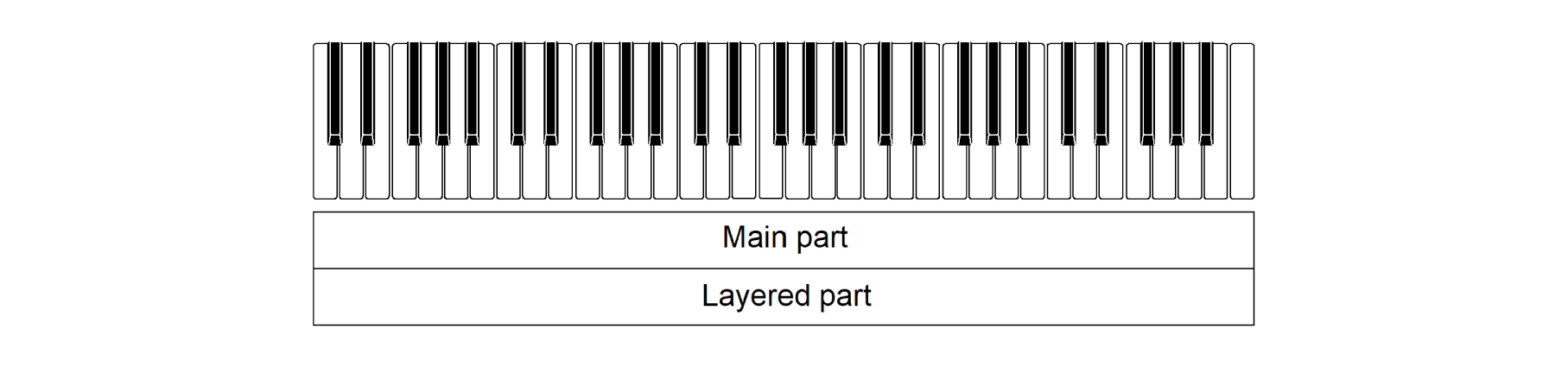
Layering and playing two tones
To play two tones layered on each other, you must switch the layer on.
-
Select the first tone (main part tone).
-
Refer to “Selecting a Single Tone” for how to select a tone.
-
-
Press and hold the FUNCTION button, and press the G2 key.

-
Each press of the G2 key toggles between on and off. A notification tone signals which setting you have switched to after you press a key.
Notification tone
Setting
High note plays
On
Low note plays
Off (default setting)
-
Once you confirm that the layer has been switched on, you can release the FUNCTION button. You can also hold the FUNCTION button down and proceed to step 3.
-
-
Select the second tone (layered part tone) to be layered.
(1) Press and hold the FUNCTION button, and press the A2 key.
-
Do not release the FUNCTION button until step (3).

(2) Press a key from C2 to C7 to select a tone.
-
Each time you press a key, the selected tone is heard. As long as the FUNCTION button is held down, you can change the tone as many times as you want by pressing the keys.
-
For the tones assigned to each key, see “Tone List”.
(3) To exit the settings, release the FUNCTION button.
-
The tone corresponding to the last key pressed becomes the tone of the layered part.
-
When you play a key, the main part and the layered part (two tones) play together.
-
Turning off the layer
-
When the layer is on, hold down the FUNCTION button and press the G2 key.
-
When you play a key, only the main part sounds.
-
Adjusting the volume of each part (part volume)
The respective volumes for the main and layered parts can be set to a value from 0 to 127 (default value for the main part: 127, default value for the layered part: 80).
-
For the main part and the layered part, see “Layering Two Tones”.
Adjusting the volume of the main part
-
Press and hold the FUNCTION button, and press the F{3 key.
-
Do not release the FUNCTION button until step 3.

-
-
Use the C4 to E5 keys to change the volume setting.
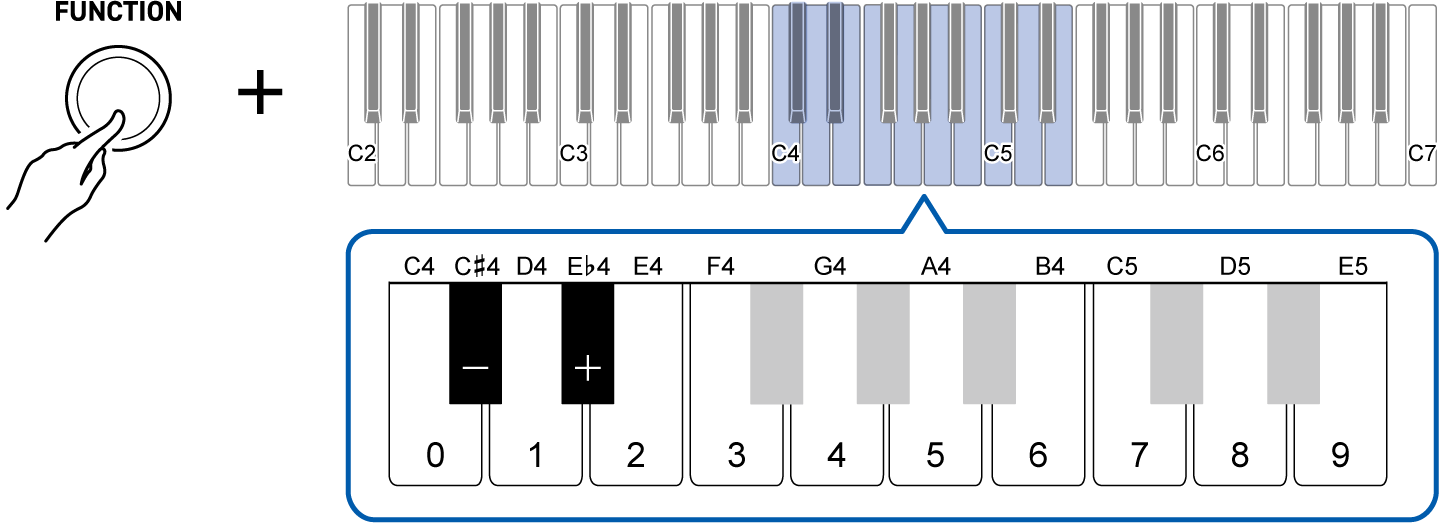
To do this:
Operate as follows:
Lower the volume setting by 1
Press the C{4 (–) key.1
Raise the volume setting by 1
Press the E}4 (+) key.1
Directly input the volume setting
Use the C4 (0) to E5 (9) keys to enter a three-digit value.For 20, press “0-2-0”. For 120, press “1-2-0”. The volume setting changes when the third digit is entered.2
Restore the default value
Press the C{4 (–) key and the E}4 (+) key at the same time.
-
Press and hold to change the value continuously.
-
Even if you have only entered two digits or less, releasing the FUNCTION button will confirm the value already entered (e.g., if you press “1-2” and then release the FUNCTION button, the volume value will be 12).
Note:
Even while the FUNCTION button is held down, playing any key other than C4 to E5 will produce an instrument sound. You can check the volume by playing the keyboard while making this setting.
-
-
To exit the settings, release the FUNCTION button.
Adjusting the volume of the layered part
In step 1 of “Adjusting the volume of the main part”, press the A}3 key instead of the F{3 key.

After that, the operation is the same as that for the main part.
Changing the pitch of each part in octave units (part octave shift)
You can raise or lower the pitch of the main part and layered part respectively, from –3 to +3 octaves (default value: 0).
-
For the main part and the layered part, see “Layering Two Tones”.
Changing the pitch of the main part in octave units
-
Press and hold the FUNCTION button, and press the C{3 key.
-
Do not release the FUNCTION button until step 3.

-
-
Press the C{4 or E}4 key.

To do this:
Operate as follows:
Lower the pitch one octave
Press the C{4 (–) key.
Raise the pitch one octave
Press the E}4 (+) key.
Restore the default value
Press the C{4 (–) key and the E}4 (+) key at the same time.
-
If the value is 0, a reference tone is played.
-
-
To exit the settings, release the FUNCTION button.
Changing the pitch of the layered part in octave units
Using step 1 of “Changing the pitch of the main part in octave units”, press the E}3 key instead of the C{3 key.

After that, the operation is the same as that for the main part.